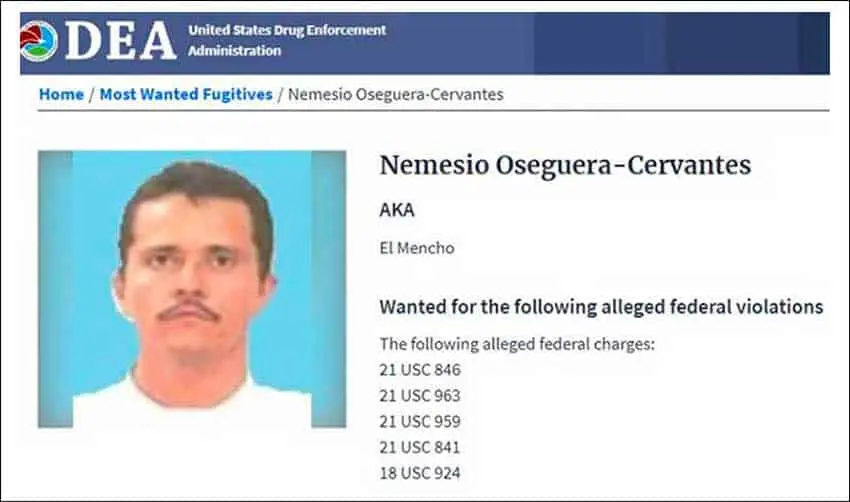

The death of Nemesio Oseguera Cervantes, the elusive and ruthless Mexican drug lord known as El Mencho, has ignited a storm of chaos throughout Mexico, with cartel enforcers torching vehicles, erecting barricades, and clashing with security forces, leaving American tourists stranded and compelled to shelter in place in popular resort areas.
In the rugged hills of Jalisco state, where El Mencho had evaded capture for over a decade, Mexican special forces launched a daring raid on Sunday, February 22, 2026, that ended with the kingpin’s demise. What followed was a predictable yet terrifying backlash: a coordinated spree of violence that rippled from the cartel’s heartland to distant corners of the country, underscoring the fragile grip of law and order in a nation long besieged by organized crime.
The Hunt for a Shadowy Figure Ends in Gunfire
For years, Nemesio Oseguera Cervantes loomed as a ghost in Mexico’s drug wars—a man whose name evoked fear among rivals, law enforcement, and civilians alike. Born in a modest village in Michoacán state, he began his criminal ascent in the 1990s, initially as a low-level operative in the Milenio Cartel before breaking away to form the Jalisco New Generation Cartel, or CJNG, around 2010. Under his command, the CJNG transformed into one of the world’s most formidable criminal enterprises, dominating the production and smuggling of methamphetamine, fentanyl, and heroin into the United States. His tactics were brutal: assassinations, beheadings, and the deployment of improvised explosive devices became hallmarks of his reign.
The operation that felled him unfolded in Tapalpa, a quaint town nestled in the Sierra de Tapalpa mountains, about 100 miles south of Guadalajara. Acting on precise intelligence—much of it reportedly supplied by U.S. agencies—Mexican marines and army units surrounded a fortified compound where El Mencho was hiding. The ensuing firefight was intense, lasting several hours. According to Mexico’s Secretariat of National Defense, El Mencho sustained fatal wounds during the confrontation and died en route to Mexico City, where he was to be interrogated. Four of his bodyguards perished in the clash, and authorities seized an arsenal that included rocket launchers, grenades, and armored vehicles—testimony to the cartel’s military-grade capabilities.
Mexican President Claudia Sheinbaum, in a nationally televised address that evening, described the outcome as a “decisive blow” against organized crime. “This operation demonstrates our unwavering commitment to justice and security,” she said, crediting collaboration with international partners, including the United States. The U.S. Drug Enforcement Administration, which had placed a $10 million bounty on El Mencho’s head, echoed her sentiments, calling his death a milestone in the fight against fentanyl trafficking, which has ravaged American communities.
Yet, even as officials celebrated, the ground was already shifting. Whispers of the raid spread like wildfire through cartel networks, triggering a pre-planned retaliation designed to paralyze the region and assert dominance.
Killing of Mexican Drug Lord Ignites Chaos as U.S. Tourists Shelter in Place
The reprisals began almost immediately, transforming bustling cities into battlegrounds overnight. In Guadalajara, Jalisco’s capital and a hub of commerce and culture, residents awoke to the acrid smell of burning rubber as cartel members set fire to dozens of buses and trucks, creating impromptu roadblocks that severed major highways. Social media flooded with videos of armed men in tactical gear patrolling streets, while helicopters thundered overhead, ferrying reinforcements for federal forces.
The violence wasn’t confined to Jalisco. Reports poured in from at least 10 other states, including Michoacán, Guerrero, Tamaulipas, and Nuevo León, where similar tactics disrupted daily life. In Puerto Vallarta, a coastal paradise known for its pristine beaches and luxury resorts, tourists watched in horror as plumes of smoke rose from torched vehicles near the airport. “It was like a scene from a movie,” recounted Eugene Marchenko, an American visitor from Chicago, who spoke to reporters from his hotel room. “We heard gunshots in the distance, and then the streets just emptied.”
By Monday morning, schools across affected regions had shuttered, businesses closed their doors, and public transportation ground to a halt. Jalisco’s governor, Enrique Alfaro, took to X (formerly Twitter) to urge calm: “We are working tirelessly to restore order,” he posted, acknowledging the blockades as attempts to “hinder authorities.” Security analysts, however, painted a grimmer picture. “This is the cartel’s way of showing they’re not defeated,” said Falko Ernst, a senior analyst at the International Crisis Group. “El Mencho’s death creates a power vacuum, but the CJNG’s infrastructure is too entrenched to crumble overnight.”
The human toll mounted quickly. At least a dozen civilians were reported injured in crossfire, and several law enforcement officers sustained wounds in skirmishes. In one particularly brazen incident, cartel gunmen ambushed a military convoy in rural Michoacán, leading to a prolonged shootout that left vehicles riddled with bullets.
Trapped in a Vacation Nightmare: Americans Caught in the Crossfire
For the thousands of U.S. tourists who flock to Mexico each year seeking sun, sea, and serenity, the unrest turned dream getaways into harrowing ordeals. Puerto Vallarta, with its vibrant boardwalk and all-inclusive resorts, became a focal point of the crisis. As news of El Mencho’s death broke, the U.S. State Department issued an urgent alert: “Seek secure shelter and avoid travel,” it advised, listing Jalisco and surrounding states as high-risk zones.
Hotels in the area swiftly activated emergency protocols, barricading entrances and advising guests to remain indoors. Adriana Belli, a tourist from New York, described the atmosphere as “eerie and tense.” “We were supposed to be sipping margaritas by the pool,” she told Fox News. “Instead, we’re glued to our phones, waiting for the all-clear.” At Guadalajara’s international airport, panic ensued as passengers scrambled amid rumors of approaching gunmen, leading to evacuations and flight cancellations.
Major airlines, including American, United, and Delta, suspended services to Puerto Vallarta and Guadalajara, stranding hundreds. Air Canada followed suit, citing “ongoing security concerns.” The U.S. Embassy in Mexico City expanded its advisory, urging citizens to “minimize movements and monitor local media.” Similar warnings came from Canada and European nations, highlighting the international ripple effects.
The economic fallout was immediate. Mexico’s tourism industry, which generates billions annually, braced for cancellations. In Puerto Vallarta alone, hotel occupancy plummeted by 50 percent within hours, according to local chamber of commerce estimates. “This could set us back months,” lamented a resort owner who spoke on condition of anonymity, fearing cartel reprisals.
A Legacy of Blood: The CJNG’s Rise and the Ongoing Drug War
El Mencho’s story is emblematic of Mexico’s entrenched narco-conflict, which has claimed over 400,000 lives since the government launched its anti-cartel campaign in 2006. From humble beginnings as a migrant farmworker in California—where he was once deported for drug offenses—he built the CJNG into a multinational behemoth, with tentacles reaching Asia for precursor chemicals and Europe for distribution.
The cartel gained notoriety for its audacity, downing a military helicopter with a rocket launcher in 2015 and orchestrating mass graves that shocked the nation. El Mencho’s elusiveness was legendary; he reportedly underwent plastic surgery and relied on a network of corrupt officials to stay hidden. His family ties added layers: His son and daughter faced U.S. charges, further straining bilateral relations.
The U.S. role in his downfall underscores the intertwined fates of the two nations. With fentanyl overdoses killing nearly 100,000 Americans yearly, pressure from Washington—amplified under the second Trump administration—pushed Mexico to act. “This is a win, but the war isn’t over,” noted Christopher Landau, a former U.S. ambassador to Mexico, in a social media post.
Experts caution that El Mencho’s death may splinter the CJNG, leading to infighting or alliances with foes like the Sinaloa Cartel. “Fragmentation often breeds more violence,” warned Vanda Felbab-Brown of the Brookings Institution. Indeed, past takedowns—such as the 2016 arrest of Joaquín “El Chapo” Guzmán—sparked similar upheavals.
Pathways to Peace Amid Persistent Peril
As federal troops cleared barricades and restored highways by late Monday, a tentative calm returned to some areas. Yet, sporadic gunfire in remote villages served as a reminder of the cartels’ enduring power. President Sheinbaum pledged increased deployments, but critics argue that without addressing poverty, corruption, and U.S. drug demand, such victories are pyrrhic.
For the tourists still confined to their rooms, the ordeal highlighted the risks of travel in a country where beauty and brutality coexist. As one stranded family from Texas put it, “We’re just grateful to be safe, but this changes how we see Mexico forever.”
This article is based on reports from BBC, CNN, NBC, Fox News, The New York Times, and other media outlets.
Focus keywords: El Mencho killed, Mexico cartel violence, US tourists shelter in place, Jalisco New Generation Cartel, Puerto Vallarta chaos, Mexican drug lord death, travel warnings Mexico 2026